
It’s 2010. I am in my mid-to-late-twenties with my soon-to-be wife, sitting on a bus from Salta to Buenos Aires in Argentina. The distance between the two cities is roughly 800 miles, and hence we are staring down the barrel of a 24-hour journey in a seat that reclines approximately 3 degrees. Fortunately, I have a pack of diazepam to take the edge off.
I pop a couple of tablets and await the warm, fuzzy embrace of tranquillity which usually leads to a deep and drooly sleep. Transport and accommodation all in one package.
But this is Argentina, and unlike the more northerly South American countries we have travelled from, the buses are top-notch – and I don’t just mean by the standards of the continent.
Before sleep can take me, I am presented with a glass of champagne, followed by a steak dinner, finally washed down with a glass of Malbec from Mendoza – I am not joking; this is (or at least was) the standard. With previous buses, the only option had been chicken, and those were still alive and roaming around on the floor.
I soon regretted having taken the diazepam – and not just because one should not mix benzodiazepines with alcohol! – as I found myself not too keen on the idea of being unconscious. The bus journey was far too luxurious to waste on sleep!
Instead, I sat there and allowed my mind to wander off into a fantasy world – as it had done since I was a young child.
Unbidden thoughts start to arrive, such as:
- What if there was a land which had an enormous monolith on each compass extreme?
- What if each monolith represented a unique form of magic?
- What if there were certain people who could bond with one of these monoliths and command the corresponding magic?
- And what if someone came along who had the unique ability to bond with all four monoliths and create magical combinations that had never before been experienced?
- What if everyone on this land looked to this unique magical wielder to save them from complete doom?
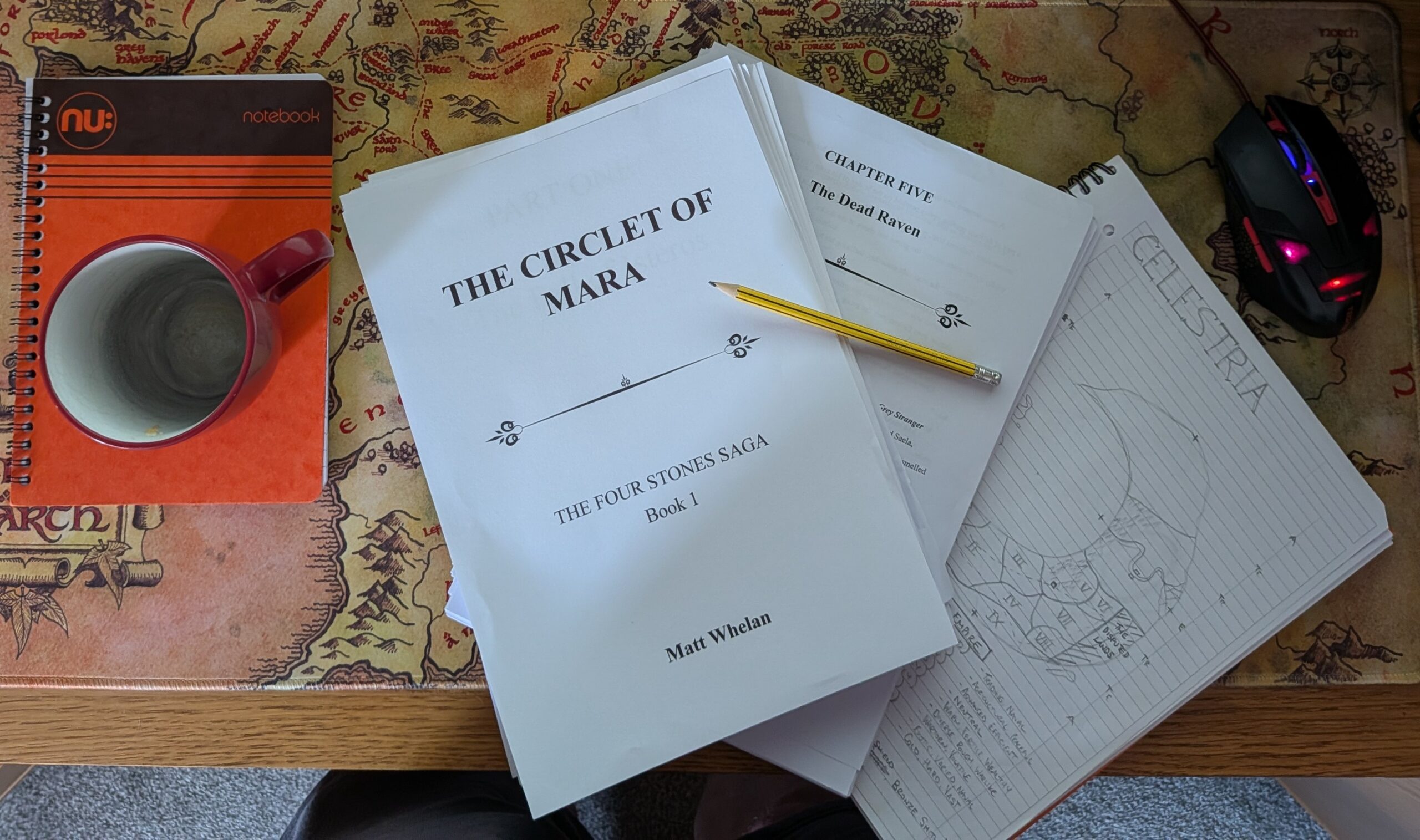
I ripped out the pages of the A4 exercise book I had been using to practise Spanish and drew a map of the land that is now known as Celestria.
Throughout our 11-month trip around the world, I added to the map. Mountain ranges in the central highlands, an unnamed city split in half by a mighty river, the Nine Kingdoms that comprised the new Empire. An endless cascade of thoughts repeatedly badgered me throughout the trip and never once stopped.
Fast forward to 2025 and what fifteen years previously had been a simple thought on a bus, was now over a decade’s worth of notes and maps scattered across numerous notebooks, spreadsheets packed with character information, and countless word documents full of ancient Celestrian lore.
I am no longer in my twenties and travelling the globe (sadly). I am now 41 years of age; I have a wife, two children, a rescue dog (with serious personality flaws), and three jobs.
I have little-to-no time to write what has now become (in my mind) a six-to-seven book fantasy series. Yet still the ideas keep on coming, fast and relentless.
Apart from a completed prologue and a half-hearted attempt on the first few chapters (totalling about 10,000 words), I hadn’t really written anything on the ‘front end’; the ‘back end’ work, however, never ceased.
The problem was that I had so many characters, plot ideas, maps, and lore to contend with that I didn’t know where to begin. With each passing day, the magical system became more intricate, but the more ideas I added to the back end, the more intimidating making a serious start on the front end became.
What I really needed was an effective way of organising all of my notes, documents, maps, and ideas into a cohesive framework for the series.
Enter artificial intelligence.
AI-assistance (back end)
By this point, I had already written and independently published several fiction and non-fiction books without AI. Writing wasn’t new to me, but The Four Stones Saga was a very different proposition: bigger, more complicated than anything I had attempted before.
As I write this in mid-to-late 2026, I probably don’t need to tell anyone how useful AI can be, particularly when used to collate, compile, and organise lots of disordered and barely cohesive strands of information.
My opinion on the development of AI – prior to using it with my writing – was probably best described as ‘equal parts fascinated and horrified’. It became something of an obsession of mine.
I would keep up-to-date on the latest developments in the field, listen to tons of podcasts featuring AI experts – from utopian tech entrepreneurs to AI-doomers and technology ethicists – and constantly push the models’ capacity with my own prompts. I could not help but think that we were witnessing the start of a civilizational level change, not unlike the Industrial Revolution and perhaps more impactful. To this day, I still don’t know if AI will bring about a utopian future as portrayed in Star Trek, or our complete doom a la Terminator 2: Judgement Day.
By this point, I had already used AI – cautiously, but to great effect in my professional life – having spent plenty of time learning its strengths and vulnerabilities. So, why not use it to help gather my ideas cohesively and put myself in a position where I could begin writing my story?
At first, I uploaded my documents and pictures and then fired all my ideas into the mixer.
Unlike fellow humans, it never ran out of patience with me when I changed course, added new ideas, removed defunct details, and played with small and seemingly irrelevant details.
Slowly but surely, a series outline began to take shape.
With this tackled, I zoomed in on Book 1. Key points in the story were examined in more detail. Character arcs became more fleshed out. Transitions between the key scenes explored. The plotline was structured so that each scene served the central theme of the book.
This was remarkable. I was getting somewhere… fast! But the truly amazing thing about the experience was that the AI rarely forgot anything I told it.
It was like having a writing partner, always at my beck and call, with an incredible memory, who never got bored, tired, or frustrated with me. A partner that could help me structure all those accumulated ideas in a fraction of the time. As a man juggling with next-to-zero free time, this was a total game changer.
With the scaffolding erected, I was ready to start laying the first bricks.
AI-editing (front end)
With the plot outline rock solid, the words came easily and the first draft poured onto the pages.
Different writers have various ways they treat their first drafts. Some pour their raw thoughts onto the page, foregoing literary flourishes – and in many cases, grammar and punctuation (that is not meant as a sarcastic indictment, by the way) – knowing they can come back to it later. Others (usually those who don’t care for editing) try to get it perfect the first time. This invariably takes longer, but shortens the need to polish the prose in future drafts.
I write somewhere between these two states. I dump my thoughts onto the page, rough and raw. But rather than writing the whole manuscript in this fashion, I stop at the end of the first chapter, go back to the beginning and edit before moving on to the next chapter. In essence, I do two passes: the first focusing on plot and structure, the second for spelling, grammar, and typos.
My writing flow looks like this:
Chapter One (First Draft) -> Chapter One (Second Draft) -> Chapter Two (First Draft) -> and so on…
Once I’ve finished my first draft of a manuscript, it looks a lot like a second draft, and only then do I begin the editing phase on the whole works.
This is no small part because I really do not like editing. I know plenty of writers who share this view, and many writers who adore the editing phase. In fact, there’s slightly more nuance to it than that.
I really enjoy professional editing. The back and forth between myself and my (excellent) editor, Ian, is one of the most enjoyable phases of any book I have published. Ian is a wonderful professional with a great sense of humour, and we work together really well. It is great to have a fresh pair of eyes go over the work, catching mistakes, and suggesting improvements.
But there are a couple of stages before my work reaches Ian’s desk. The third and fourth (and sometimes fifth) drafts are, for me, an agonising and lonely process of self-editing. I really can’t stand re-writing what has already been written. I find it very difficult to delete large chunks of text, even if deep down I know they must go. During this process, I quickly reach a saturation point where I am sick to death of my own story and just want to move onto the next book.
Once again, I found using AI a real tonic for this phase of the manuscript.
The earlier iterations of AI were poor for this. I would feed in a chapter and receive feedback which either missed the point, or in some cases suggested that I include something that already existed in the text. When questioned, it would apologise but offer no explanation.
It was hard to trust it, yet even the worst iterations of AI would also make valuable observations and suggestions. So, I learned to be cautiously open-minded and filter the wheat from the chaff of the feedback.
As technology progressed, AI became an even better editing partner. It made fewer mistakes, in part because the AI iterations were getting more powerful, but also because the more story I fed in, the more it knew and understood about my vision for the book. The more I trusted it, the more I was willing to use it, and the better it got, and hence the more I trusted it, and so on.
Book 1 is set in the Shattered Isles of Celestria, a region peppered with small islands. There is frequent travel between the islands, which necessitated a lot of prose that dealt with sailing. Having little knowledge of medieval sea voyages and the constituent parts of old wooden craft, I leaned heavily on AI for certain descriptions. In many places, I would throw in a very rough prompt about what I wanted the paragraph or scene to say, and allow AI to generate the prose. I would then heavily edit the output and end up with text that is part-generative and part-me.
Other times, when I was struggling to get my character from A to B – or just not fully in the optimum creative headspace – I would type a rough outline of what I was trying to say and get AI to suggest some outputs. Again, I would either disregard this or heavily edit it until it became something indistinguishable from how I would write. This enabled me to not waste those rare moments I had set aside for writing, and keep the book progressing, even during times of mental switch off.
In many cases, this process did not even save time, such was the intensity of my edits; it was merely an alternative way of arriving at the same destination.
At this stage, it is impossible to tell you exactly what percentage of the finished prose originated with me, originated with AI, or began with one and was reshaped by the other. The two have become far too intertwined.
What I can say honestly is that AI has contributed in some way to a substantial proportion of the prose in Book One, far beyond simple proofreading or occasional assistance. Pretending otherwise would rather defeat the purpose of writing this article.
The ethics of AI-assisted writing
Throughout this process, I can honestly say I spent very little time wrestling with the obvious ethical conundrum that using AI to write throws up. I was too busy enjoying myself and getting thoughts that had been trapped in my brain onto the page.
There were some rare occasions when a paragraph of AI-generated text came out exactly as I wanted it. So perfect, in fact, that I didn’t want to change anything. In those moments, I would look at the paragraph and think, “I didn’t write that at all”. And yes, in those instances, I got the moral ick. But at those rare times, I would make the prose pass a few basic tests:
- Is this paragraph cohesive with what came before?
- Does it match my writing style?
- Could, or would, I have written that?
- Would editing this paragraph make it better?
I understand why many people would be uncomfortable with reading a book in which AI had been involved, particularly with the front end. I get it. 100%.
So, the question is… why am I not?
I have rolled this issue around in my head, and the best answer I can come up with is: I’ve always cared more about how a creative work affects me, rather than the technical process used to produce it. Let me give you a practical example:
Back in my early twenties, I would go clubbing most weekends. It is what I spent all my disposable income on. I loved the underground house and techno scene in Liverpool and dancing with my closest friends. Sometimes I would go to see a DJ playing on vinyl turntables. Other times, the person in the DJ booth would have a laptop open and would be mixing with CDJs or Ableton Live. I honestly didn’t care about the setup, or that the DJ using Ableton Live could benefit from an auto beat-matching function (although I had friends to whom it really mattered); what I cared about was how the music they were playing made me feel on the night.
I don’t want to get drawn into the argument about how technology progresses. I don’t seek to compare the use of AI for generative prose to the development of the typewriter or the advent of the spellchecker. I understand neither of those technologies was contributing creatively to the text, even if they were saving the writer time and effort.
But the reality is that this is a tool that is now available, and we can either utilise or ignore it. I don’t believe there is a right or wrong answer so long as the spirit and intent of the writer ends up on the page.
Of course, this explanation leads to an obvious question…
If I have no moral quandary with using AI, why write this article?
In the summer of 2026, just before we left for our amazing trip to the Norwegian fjords, I came across a news story. Jerry Falade’s debut crime novel, Call Me, I’ll Hide the Body – which had attracted a multimillion-dollar publishing offer – became subject to immense media scrutiny. The deal collapsed after questions were raised about how the manuscript had been created. The author denied using AI, and his agents said they did not rely on AI-detection software. In the end, they withdrew representation because they felt they could no longer confidently authenticate the manuscript’s development after inconsistencies emerged in subsequent discussions.
Not totally up on the world of traditional publishing, I did some digging to see how the trad-publishing world was contending with modern AI use in writing. The answer was: it has become a major struggle for the industry. In short, they were (and still are) grappling with three different areas:
Reliability of AI detection – AI-detection software has become one of the tools available to publishers, agents, and others trying to identify generative content, but its reliability remains contested and these searches have historically yielded false positives (such as the time a popular detector flagged Mary Shelley’s Frankenstein as 100% AI-generated) which can leave authors facing questions about provenance, and in some cases, needing to dig up old notes, and hope they have kept enough draft evidence to satisfy the publishers.
Contractual grey areas – Strict “no AI” clauses in legal agreements between publishers and authors often lack clear definitions and therefore fail to distinguish between what most would deem ‘acceptable’ AI use (advanced spell checking and editing software) from generating large chunks of prose.
Loss of author trust – high-profile cases such as the one mentioned above have caused huge anxiety among authors who fear algorithms may (rightly or wrongly) destroy their writing career before it can have a chance to take off.
Now… just to make my position perfectly clear.
I write for myself, as a hobby first and foremost.
When I write or plan my stories, I write them as if my friends and family are the only ones who are ever going to read them.
I spend very little time (and should probably spend more) focusing on the wider reading market, identifying sub-genre criteria, reader demographics, and the target age range of my writing.
I write what I want, even if it means making my books less marketable.
Would it be nice if my books became a huge success? Of course!
Wouldn’t it be great if I had a portfolio of work that was both self-and-traditionally published? Yes.
But commercial success and fame are not my goals.
My goal is to get the stories, scenes, and characters that would otherwise clog up my brain out of my head and onto the page. I feel tremendous relief when I do this, and take great joy in reviewing the final product.
I write because I must.
And so, I concluded that if I am going to write, then I shall write what I want, and how I want.
The problem arrived when I discussed the issue with my wife.
My wife has been a loyal alpha reader of all my works and an invaluable source of feedback and support. Of all my works, she has been most enthusiastic about The Circlet of Mara – high praise from someone who doesn’t typically read fantasy – and has been reading the story in real time; as soon as I produce a new chapter, she reads it.
I mentioned to her the issues that the traditional publishing industry and aspiring authors face in the new world of AI, and how my use of AI could potentially prohibit the trad-publishing path.
It turns out that I had overlooked something pretty crucial.
My wife had no idea I used AI to help me with the Four Stones Saga. And her reaction to this news was not good.
Without boring you with the details, my wife was uncomfortable with my use of AI in writing the book. Even as far as using it on the back end to help with character arcs, pacing, world-building, and consolidation of lore. The biggest dagger in the heart was when she said, “I’m disappointed because I feel like I’ve been deceived.”
This came as a shock. In no small part because I have never hidden from my wife the fact that I use AI to assist with my writing on this project and therefore was ignorant of her ignorance (so to speak).
But looking back, she only ever read the output and listened to me talk about my ideas in bed. She wasn’t there for the many hours of typing, researching, planning, editing, and head-banging. So, how would she have known?
My surprise at her reaction was somewhat naïve. Just because I had reconciled the use of AI in the project does not mean that everyone else will be comfortable with it. While I may not totally share their views, I understand that some people are deeply uneasy about AI. Others have ethical, artistic, or economic objections to its use. There are many who see its use, even at a basic planning level, as invalidating the final work from an artistic point of view. These are perfectly valid opinions and make for an interesting and worthwhile debate.
It is the direct result of this (difficult) conversation with my wife that I have decided to be totally up front and transparent about my use of AI to help with the Four Stones Saga. When I get around to publishing The Circlet of Mara, I will dedicate one of the very first pages to a clear disclaimer, explaining that AI was used to develop the book and the series.
This article has been written to delve into exactly how and why I use AI and I plan to write articles in the near future featuring live examples of how my first draft is edited with the help of AI, and how this progresses into the prose of the final draft, so that readers can see how much of a typical section is my writing, how much has been AI-influenced, and how much is AI-generated.
The aim is total transparency from the outset. I would hate for any reader to have the same experience that my wife did. I don’t intend to change the way I write the Four Stones Saga, but by being up front and honest about how it has come to fruition, I can give readers who are uncomfortable with AI an opportunity to turn away and say, “this book isn’t for me” before dedicating any precious time in reading it.
One thing to make perfectly clear.
My motivation for using AI isn’t to produce as many books as possible. If it were, my writing process would look very different. My motivation for writing these stories is to project the essence and spirit of the Four Stones Saga – which has been buried in the deepest recesses of my mind for 15 years – and turn it into a complete work of fiction that has my soul at its core.
Every line of every book has been deeply scrutinised to ensure it fits with my vision for the tale. AI has contributed words to these books. I don’t hide from that. But it has not supplied the reason the books exist, the world I want to create, or the story I want to tell.
If I wanted to, I could have the whole series boxed off in less than two years. AI is now so effective, I could churn out a book in three months. But I would gain no satisfaction from that, as I could not honestly say, “this story is mine”.
I’m not advocating that anyone else should write this way. I’m not arguing that writers who reject generative AI are wrong. I’m simply being clear that this is how I have chosen to create The Four Stones Saga.
This process has clarified how I intend to publish the series. The Circlet of Mara and subsequent books in the series will be independently published. In many ways, that feels like the natural home for it: it gives me complete responsibility for the books, but also complete control over how I write them, how they are produced, and how openly I explain the process behind them.
Some readers will decide that means these books aren’t for them. It’s very possible that my wife is among them.
Others, I hope, will turn the page, enter Celestria and judge the story on what they find there.
Either way, they’ll be making that choice knowing exactly how these books were made.


0 Comments